
The Impact of Indoor Pools and Hot Tubs on Your Home’s Roof Deck and Ventilation
Indoor pools and hot tubs create a unique challenge for your home’s roof structure. The warm moist air generated by heated water rises and meets cold roof surfaces, creating condensation that can rot wood, grow mold, and compromise structural integrity. In Oklahoma City’s climate with high summer humidity and temperature swings, this problem becomes even more severe. The moisture from pool chemicals like chlorine mixes with airborne particles, creating corrosive compounds that eat away at roofing materials faster than normal humidity would. Roofing Tulsa.
Most homeowners don’t realize the damage happening above their ceilings until they see water stains or smell musty odors. By then, the roof deck may already be compromised. Understanding how pool moisture affects your roof and what ventilation systems work best can save you thousands in repairs. This guide explains the science behind pool-related roof damage and provides solutions tailored to Oklahoma City homes. EPA information on indoor air quality.
How Pool Moisture Damages Your Roof Structure
Pool water constantly evaporates into the air above it. In an enclosed space, this moisture has nowhere to go. When warm humid air contacts a cold surface like an uninsulated roof deck, the water vapor condenses back into liquid. This process happens continuously in homes with indoor pools or hot tubs.
The condensation creates several problems. First, standing water on wood surfaces leads to rot. Second, the constant moisture feeds mold growth. Third, pool chemicals in the air accelerate material breakdown. Chlorine and bromine mix with moisture to form hydrochloric acid and other corrosive compounds that eat through roofing materials. Roofing Norman.
In Oklahoma City, the problem intensifies because our climate creates bigger temperature differences. Summer heat makes pools run longer. Winter cold makes roof surfaces much colder relative to indoor pool temperatures. This wider temperature gap means more condensation forms on roof surfaces.
The Science of Dew Point and Condensation
Dew point is the temperature at which air becomes saturated with moisture and water vapor begins to condense. For indoor pools, you need to understand two key temperatures: the air temperature near the pool and the surface temperature of your roof deck.
When pool water stays at 82-86 degrees Fahrenheit, the air above it becomes very humid. If your roof deck surface temperature drops below the dew point of this humid air, condensation forms. In Oklahoma City, winter roof temperatures often drop into the 30s while indoor pool areas stay in the 70s or 80s.
The formula for dew point depends on relative humidity and air temperature. For example, air at 85 degrees with 70% relative humidity has a dew point around 73 degrees. If your roof deck surface is cooler than 73 degrees, moisture will condense on it.
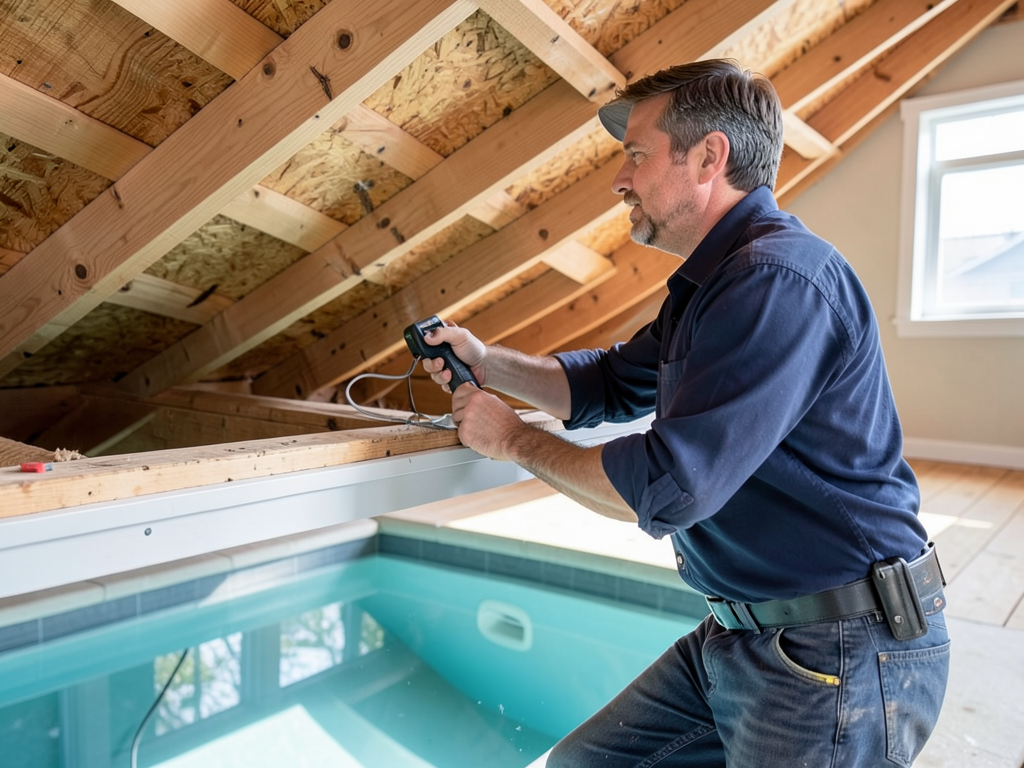
Professional roofers use moisture meters to test roof deck conditions. A reading above 20% moisture content indicates active condensation problems. The screwdriver test reveals soft spots where rot has begun. Press a screwdriver into the wood; if it sinks easily, the wood has lost structural integrity. The Best Norman OK Roofers for Emergency Storm Damage Fixes.
Vapor Barriers vs Ventilation Systems
Two approaches exist for controlling pool moisture: vapor barriers and ventilation systems. Each has advantages depending on your specific situation.
Vapor barriers are plastic sheets or specialized membranes installed on the warm side of insulation. They prevent moisture from reaching cold surfaces where it would condense. For indoor pools, the vapor barrier goes between the pool area and the roof structure.
Ventilation systems work by removing moist air before it can cause problems. They use fans to exchange indoor air with outdoor air. The calculation for proper ventilation depends on pool size, water temperature, and local climate conditions. Why Local Nichols Hills Residents Choose Our Luxury Roofing Team.
In Oklahoma City, most experts recommend combining both approaches. The vapor barrier provides primary protection while ventilation handles excess moisture during extreme conditions. This dual system prevents both condensation and chemical corrosion.
The Oklahoma Uniform Building Code requires specific ventilation rates for indoor pool areas. Section 1203.4 mandates mechanical ventilation at 0.5 cubic feet per minute per square foot of pool surface area. For a 400 square foot pool, that means 200 CFM of continuous ventilation.
Recommended Roofing Materials for Indoor Pool Areas
Not all roofing materials handle pool environments well. The constant moisture and chemical exposure require specialized products.
PVC roofing membranes offer excellent resistance to pool chemicals and moisture. The heat-welded seams create a monolithic waterproof surface. PVC reflects UV radiation, reducing heat buildup in summer. The material remains flexible in cold temperatures, preventing cracks from Oklahoma’s temperature swings.
Modified bitumen roofing with fiberglass reinforcement provides another good option. The multiple layers create redundancy if one layer fails. The granulated surface resists chemical attack better than smooth surfaces.
Metal roofing works well for indoor pool enclosures when properly coated. Aluminum resists corrosion better than steel. The key is using factory-applied Kynar or similar fluoropolymer coatings that withstand chemical exposure.
Whatever material you choose, proper installation matters more than the product itself. All seams must be sealed. Flashing details around penetrations need extra attention. The roof should slope slightly toward drains to prevent standing water.
Oklahoma City Building Codes for Pool Enclosures
Oklahoma City follows the 2021 International Building Code with local amendments. For indoor pool structures, several sections apply specifically to roofing and ventilation. International Building Code ventilation requirements.
Section 1203.4 of the Oklahoma Uniform Building Code requires mechanical ventilation for indoor pools at 0.5 CFM per square foot of water surface. The system must exhaust air near the highest point of the enclosure.
Section 1203.5 mandates dehumidification equipment when outdoor humidity exceeds 60%. Oklahoma City routinely experiences 80-90% humidity in summer, making dehumidifiers essential.
Section 1207 covers vapor retarders. For indoor pools, Class I or II vapor retarders are required on the warm side of roof assemblies. This typically means 6-mil polyethylene or foil-faced polyisocyanurate insulation.
Local amendments add requirements for ice and water shield in Oklahoma City. Section 15-36-141 requires ice and water shield extending from eaves to a point two feet inside the exterior wall. This protects against ice damming in winter.
Permit requirements vary by project scope. Enclosing an existing pool typically requires building, mechanical, and electrical permits. The building department reviews ventilation calculations and vapor barrier specifications before issuing permits.
Case Study: Pool Roof Restoration in Nichols Hills
A recent project in the Nichols Hills area demonstrates the importance of proper pool roof design. The homeowner noticed water stains on their ceiling and called for inspection.
Our team found extensive damage. The original roof had standard asphalt shingles over minimal ventilation. Pool moisture had condensed on the underside of the roof deck, causing rot in multiple rafters. Mold covered the underside of the decking.
We removed the entire roof assembly down to the trusses. The vapor barrier was deteriorated from chemical exposure. The insulation was saturated and compressed.
The restoration involved installing a new PVC membrane roof with enhanced ventilation. We added ridge vents and gable vents to create cross-ventilation. A new vapor barrier went between the pool area and roof structure. We upgraded to R-38 insulation to maintain temperature differentials.
The total project cost $28,000, but prevented further structural damage. The homeowner reported no moisture issues in the following winter, even during extreme cold snaps.
Preventing Structural Rot in Roof Decking
Once rot begins in roof decking, it spreads quickly. The fungi that cause rot need moisture, oxygen, and organic material to grow. Pool environments provide all three continuously.
Early detection saves money. Look for these signs: soft spots when walking on the roof, water stains on ceilings below, musty odors in attic spaces, and visible mold growth. A moisture meter reading above 20% indicates active problems.
Prevention starts with proper design. The roof assembly should include a drainage plane to channel any water that penetrates the outer layer. This typically means installing a secondary water barrier under the primary roofing material.
Ventilation calculations matter. Too little ventilation allows moisture buildup. Too much ventilation in winter can create negative pressure that pulls moist air through the building envelope. The right balance depends on pool size, water temperature, and local climate.
In Oklahoma City, we recommend at least one square foot of net free ventilation area per 300 square feet of ceiling area. This assumes balanced intake and exhaust ventilation. For indoor pools, increasing to one square foot per 150 square feet provides extra protection.
Chloramine Gas and Roofing Material Degradation
Pool chemicals create more than just moisture problems. When chlorine reacts with nitrogen compounds in sweat, urine, and organic debris, it forms chloramines. These compounds off-gas into the air above the pool.
Chloramines are highly corrosive. They attack metals, break down plastics, and degrade many roofing materials. The characteristic “chlorine smell” in indoor pools comes from these compounds.
The corrosion process accelerates in warm environments. Pool areas typically stay between 78-82 degrees, which speeds chemical reactions. The constant air movement from ventilation systems distributes chloramines throughout the roof cavity.
Materials resistant to chloramine exposure include PVC, certain grades of stainless steel, and specially formulated synthetic rubbers. Standard roofing materials like asphalt shingles degrade much faster in chloramine-rich environments.
Testing for chloramine damage involves checking for material embrittlement, color changes, and surface pitting. A simple test uses pH strips; chloramine-contaminated surfaces often show pH levels between 3-5, indicating acidity.
R-Value Insulation Requirements for Indoor Pool Ceilings
Proper insulation serves two purposes in indoor pool areas: energy efficiency and condensation prevention. The right R-value keeps the roof deck surface temperature above the dew point of the indoor air.
Oklahoma falls in climate zones 3 and 4, requiring different insulation approaches. Zone 3 (southern Oklahoma) needs R-30 to R-38 in ceilings. Zone 4 (northern Oklahoma including Oklahoma City) requires R-38 to R-49.
For indoor pools, we recommend the higher end of these ranges. The extra insulation provides a safety margin for condensation control. In practice, this means installing R-49 fiberglass batts or blown-in cellulose, or using spray foam for its superior air sealing properties.
The insulation must be installed without gaps. Even small voids allow moist air to reach cold surfaces. Compression reduces effective R-value, so insulation should not be squeezed into place.
Continuous insulation boards provide better performance than cavity-fill insulation alone. Installing rigid foam over the roof deck creates a thermal break that prevents condensation on the underside of the deck.
Active vs Passive Ventilation for Pool Areas
Ventilation systems fall into two categories: active and passive. Each has specific applications for indoor pool environments.
Passive ventilation relies on natural air movement through vents, windows, or other openings. It works best in moderate climates with significant temperature differences between indoor and outdoor air. In Oklahoma City’s climate, passive ventilation alone rarely provides adequate moisture control for indoor pools.
Active ventilation uses powered fans to move air. This includes exhaust fans, supply fans, and heat recovery ventilators. Active systems can maintain specific air exchange rates regardless of outdoor conditions.
For indoor pools, active ventilation offers several advantages. It can maintain negative pressure in the pool area to prevent moisture migration to other parts of the house. It allows precise control of air exchange rates. It can incorporate heat recovery to reduce energy costs.
The downside of active systems includes higher initial cost and ongoing electricity use. They also require regular maintenance of fans and controls.
Most successful indoor pool installations in Oklahoma City use active ventilation with passive backup. The active system handles normal moisture loads while passive vents provide redundancy during power outages.
Maintenance Schedule for Pool Roofs
Regular maintenance prevents minor issues from becoming major problems. A consistent inspection schedule catches damage early.
Monthly checks should include: inspecting ceiling surfaces for water stains, checking humidity levels with a hygrometer, listening for unusual fan noises, and verifying that vents are not blocked.
Quarterly maintenance involves: cleaning vent screens, checking fan belts and bearings, inspecting roof surface for damage, and testing moisture levels in accessible areas.
Annual professional inspection should include: thermal imaging to detect hidden moisture, core sampling of roof deck to check for rot, inspection of all flashing details, and verification of ventilation system performance.
Oklahoma’s severe weather creates additional maintenance needs. After hailstorms, check for membrane punctures. After high winds, verify that vents remain secure. After extreme temperature swings, check for material contraction gaps.
Document all inspections and maintenance. This history helps diagnose recurring problems and proves due diligence if warranty claims arise.
Cost Factors for Pool Roof Ventilation Upgrades
Upgrading pool roof ventilation involves several cost components. Understanding these helps budget appropriately.
Material costs vary by system type. Basic ridge vents cost $3-5 per linear foot. Powered exhaust fans range from $200-800 each, plus electrical hookup costs. High-end heat recovery ventilators can cost $2,000-4,000.
Labor costs depend on roof complexity and accessibility. Simple ranch homes cost less to work on than multi-story homes with complex rooflines. Expect $50-100 per hour for qualified roofing contractors in Oklahoma City. What You Can Expect to Pay for a Roof Replacement in Edmond.
Permit fees in Oklahoma City typically range from $100-500 depending on project scope. Electrical permits add $50-150 if new circuits are needed.
Unexpected costs often arise during demolition. Rotted decking, inadequate structural support, or outdated wiring can add $1,000-5,000 to projects.
The total cost for a complete pool roof ventilation upgrade typically ranges from $5,000-15,000. This includes materials, labor, permits, and some contingency for unexpected issues.
Consider this an investment. Proper ventilation can extend roof life by 10-15 years and prevent thousands in water damage repairs.
Energy Efficiency Considerations
Pool roof ventilation affects more than just moisture control. It impacts your home’s overall energy efficiency.
In winter, heated indoor air escapes through ventilation systems. This forces your heating system to work harder. Heat recovery ventilators capture 60-80% of this heat before it leaves the building.
Summer presents different challenges. Outdoor heat enters through ventilation, making your air conditioner work harder. Proper insulation and radiant barriers reduce this heat gain.
The energy cost of running ventilation fans varies. A typical 200 CFM exhaust fan uses about 150 watts. Running continuously costs approximately $130-150 per year at Oklahoma’s average electricity rates.
Balancing moisture control with energy efficiency requires careful system design. Variable speed fans adjust airflow based on humidity levels. Timers can reduce ventilation when the pool is covered.
Oklahoma’s extreme seasons make this balancing act more challenging. Systems must handle 100-degree summer days and 20-degree winter nights while maintaining proper moisture control year-round.
Frequently Asked Questions
How do I know if my indoor pool is causing roof damage?
Look for water stains on ceilings below the roof, musty odors in attic spaces, soft spots when walking on the roof, and visible mold growth. A moisture meter reading above 20% on the roof deck indicates active condensation problems.
What’s the best roofing material for indoor pool areas in Oklahoma?
PVC roofing membranes offer the best combination of chemical resistance, moisture protection, and temperature flexibility for Oklahoma’s climate. The heat-welded seams create a monolithic waterproof surface that withstands both pool chemicals and extreme temperature swings.
How much ventilation does my indoor pool need?
The Oklahoma Uniform Building Code requires 0.5 cubic feet per minute of mechanical ventilation per square foot of pool surface area. For a 400 square foot pool, that means 200 CFM of continuous ventilation. Most experts recommend 30-50% more than code minimum for Oklahoma’s humid climate.
Can I use my existing roof vents for pool moisture control?
Standard roof vents are not designed for the high moisture loads from indoor pools. Pool areas need dedicated exhaust fans and properly sized intake vents to maintain the negative pressure required to prevent moisture migration to other parts of your home.
How often should I inspect my pool roof?
Perform visual checks monthly, clean vents quarterly, and schedule professional inspection annually. After severe weather events like hailstorms or high winds, inspect immediately for damage. Document all inspections to track changes over time.
Conclusion
Indoor pools and hot tubs create beautiful home amenities but pose serious risks to your roof structure. The combination of constant moisture, pool chemicals, and Oklahoma City’s extreme climate creates perfect conditions for roof damage if not properly managed.
Understanding the science behind pool-related roof problems helps you make informed decisions about ventilation, materials, and maintenance. The right approach combines proper vapor barriers, adequate ventilation, and moisture-resistant materials specifically chosen for your local climate.
Don’t wait until you see water stains or smell mold. By then, expensive damage has already occurred. A professional inspection can identify problems early and recommend solutions that protect your investment.
Call (405) 507-3933 today to schedule your indoor pool roof inspection. Our experienced team understands Oklahoma City’s unique climate challenges and can recommend ventilation solutions that keep your home dry and your roof healthy for years to come.
Pick up the phone and call (405) 507-3933 before the next storm hits. We’ll help you protect your indoor pool investment and prevent costly structural damage to your home.